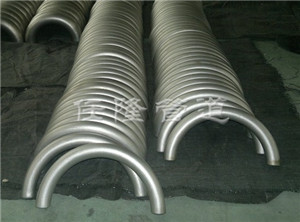
U-shaped elbow
U-bends are formed using complete sets of bending dies, with two processes: cold bending and hot pushing. Almost all types of machinery and piping systems use bends, mainly for oil transportation, gas transmission, fluid delivery, and other applications. They also play a particularly important role in aircraft and their engines.
1. During pure bending, under the action of external moment M, the outer wall of the pipe along the neutral layer is subjected to tensile stress and becomes thinner, while the inner wall is subjected to compressive stress and thickens. The resultant forces N1 and N1 cause deformation of the pipe cross-section. Based on this factor, the main reasons for the degradation of bend quality are RX and SX. Therefore, GBJ235-82 clearly specifies the RX values and outer wall thinning rates for various pressure classes, aiming to control RX and SX values and thus ensure quality.
2. As mentioned above, during pipe bending, the outer side of the material is in tension and the inner side in compression; the position of the neutral axis varies with the bending method. In compression bending, the neutral axis is located approximately 1/3 of the wall thickness from the outer wall, while in rotary bending (return bending), it is located 2/3 of the wall thickness from the outer wall. Therefore, rotary bending is advantageous for bending thin-walled pipes.
The U-bend machine is specially designed for bending U-bends, driven by hydraulic power. Actions such as pipe bending, PLC control, pipe clamping, and core insertion are fully automated. The cantilever and bending movements are synchronized, with adjustable speed during operation, effectively preventing pipe sagging during bending. Integrated die technology covers all pipe specifications and bending radii within a processing capacity of more than 10D, effectively controlling pipe springback and ensuring consistency. Bending angles are positioned using an encoder for precise accuracy and can be set arbitrarily. During operation, movements are displayed synchronously, and error messages are shown to assist operators in correct operation and troubleshooting, ensuring operator and equipment safety and eliminating potential production safety hazards.
Materials for U-bends:
Carbon steel: A3, Q235, 20#, 20G, ST45.8, A105, A106
Alloy steel: 16Mn, 12Cr1MoV, 10MCrMo910, Cr5Mo, 15CrMo, A335P11, A335T91
Stainless steel: 1Cr18Ni9Ti (18-8), 0Cr18Ni10Ti (321), 0Cr18Ni9 (304), 00Cr19Ni10 (304L), 0Cr17Ni12Mo2 (316), 00Cr17Ni14Mo2 (316L)