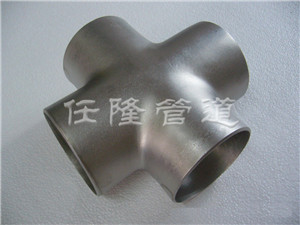
reducing cross
A cross is a pipe fitting and pipeline connector. It is also referred to as a pipe cross, cross fitting, or cross joint, and is used at points where branch pipes connect to the main pipeline.
Crosses are categorized into equal-cross and reducing-cross types. The connecting ends of an equal-cross are all of the same size; for a reducing-cross, the main pipe ends share the same diameter, while the branch pipe ends have a smaller diameter than the main pipe. A cross is a type of fitting used at pipeline branches. For crosses manufactured from seamless pipes, the two commonly used processes at present are hydraulic bulging and hot press forming.
### Hydraulic Bulging
Hydraulic bulging of crosses is a forming process that expands the branch pipe through axial compensation of the metal material. The process involves using a special hydraulic press to inject liquid into a tube blank with the same diameter as the cross. The two horizontal side cylinders of the hydraulic press move synchronously toward the center to compress the tube blank, reducing its volume. As the tube blank is compressed, the pressure of the liquid inside rises accordingly. When the pressure required to form the cross branch is reached, the metal material flows along the inner cavity of the mold under the dual action of the side cylinders and the internal liquid pressure, forming the branch.
The hydraulic bulging process for crosses enables one-step forming with high production efficiency, and increases the wall thickness of the main pipe and shoulder sections of the cross. Due to the large equipment tonnage required for the hydraulic bulging of seamless crosses, this process is mainly used domestically for manufacturing standard-wall-thickness crosses smaller than DN400. Suitable forming materials include low-carbon steel, low-alloy steel, stainless steel with relatively low cold-work hardening tendency, as well as certain non-ferrous metals such as copper, aluminum, and titanium.
### Hot Press Forming
Hot press forming of crosses involves flattening a tube blank larger than the cross diameter to approximately the cross size, and drilling a hole at the location where the branch pipe is to be stretched. The tube blank is heated, placed into a forming mold, and a punch for stretching the branch pipe is inserted inside. Under pressure, the tube blank is radially compressed; during this process, metal flows toward the branch direction and forms the branch under stretching by the punch. The entire part is formed through radial compression of the tube blank and stretching at the branch section.
Unlike hydraulically bulged crosses, the metal for the branch of a hot-pressed cross is compensated by radial movement of the tube blank, hence this process is also known as radial compensation.
Since heating is applied before pressing, the equipment tonnage required for material forming is reduced. Hot-pressed crosses have broad material adaptability, suitable for low-carbon steel, alloy steel, and stainless steel. This forming process is typically adopted especially for large-diameter and thick-walled crosses.
1. Classified by material: carbon steel, cast steel, alloy steel, stainless steel, copper, aluminum alloy, plastic, argon-leached material, PVC, etc.
2. Classified by manufacturing method: top-forming, pressing, forging, casting, etc.
3. Classified by manufacturing standards: national standard (GB), electrical standard, water standard, American standard, German standard, Japanese standard, Russian standard, etc., as detailed below: GB/T 12459, GB/T 13401, ASME B16.9, SH 3408, SH 3409, HG/T 21635, DL/T 695, SY/T 0510, DIN 2615