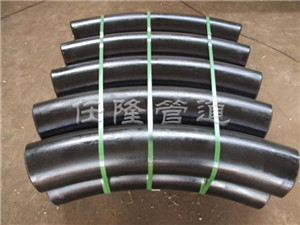
R=3D carbon steel elbow
Elbow pipes are bent using complete sets of bending dies. Almost all types of machinery and equipment mostly use elbow pipes, mainly for oil transportation, gas transmission, fluid delivery, etc. They also play a considerably important role in aircraft and their engines. Common types of elbow pipes include intermediate frequency elbow pipes, butt-welded elbow pipes, stainless steel elbow pipes, etc.
Elbow Pipe Quality Control:
1. The impact of lubrication during elbow pipe forming on product quality: In traditional elbow pipe production processes, enterprises adopt various methods to achieve better surface quality of elbow pipes, including using more advanced pipe benders, higher-strength dies, or lubrication products.
2. During pipe bending, the outer side of the material is under tension while the inner side is under compression. The position of the neutral axis varies with the bending method. In compression bending, the neutral axis is located approximately 1/3 of the wall thickness from the outer wall; in rotary bending (return bending), the neutral axis is located 2/3 of the wall thickness from the outer wall. Therefore, rotary bending is beneficial for bending thin-walled pipes.
3. The precision of bending dies is also one of the factors affecting elbow pipe quality. When manufacturing bending dies, in addition to controlling dimensional specifications within a certain tolerance range, users are also required to select corresponding bending dies according to the pipe diameter to be bent.
4. The bendability and surface corrosion condition of the pipe material itself may also affect elbow pipe quality. During on-site construction, operators need to understand the material and processing properties of the pipe to be processed and judge its surface corrosion condition.
5. In pure bending, under the action of external moment M, the outer wall of the pipe’s neutral layer is subjected to tensile stress and becomes thinner, while the inner wall is subjected to compressive stress and thickens. The resultant forces N1 and N2 cause deformation of the pipe’s cross-section. Based on this factor, the main reasons for reduced elbow pipe quality are RX and SX. Therefore, GBJ235-82 clearly specifies the RX values and outer wall thinning rates for various pressure levels, aiming to control RX and SX values and ensure quality.
Surface Treatment: Paint brushing for rust prevention; cold galvanizing and hot galvanizing treatments are also available.
Packaging: Wooden cases, wooden pallets, or other types.
Product Brand: Renlong
Origin: Yanshan County, Cangzhou City, Hebei Province