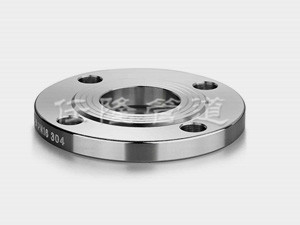
Plate Flat Welding Flange PL
Schematic Diagram of Plate-type Flat Welding Flange
Flat welding flanges are suitable for the connection of steel pipelines with a nominal pressure not exceeding 2.5MPa. The sealing surfaces of flat welding flanges can be manufactured into three types: flat face, male and female face, and tongue-and-groove face. Flat face flat welding flanges are widely used, mostly under mild medium conditions, such as low-pressure non-purified compressed air and low-pressure circulating water.
Flat welding flanges are generally referred to as flat plates, also known as lap welding flanges. The connection between a flat welding flange and a pipeline is achieved by first inserting the pipe into the inner hole of the flange to an appropriate position, followed by lap welding. Flat welding flanges are suitable for pipeline systems with relatively low pressure levels and insignificant pressure fluctuations, vibrations and oscillations. Flat welding flanges feature easy alignment during welding and assembly as well as relatively low cost, thus enjoying extensive application.
Quoted Standards:
Ministry of Chemical Industry Standards: HG20593-2009, HG20615-2009
National Standards: GB/T9119-2000, GB/T2555-81
Ministry of Machinery Industry Standards: JB/T81-94, JB/T74-94, JB/T75-94
Marine Standard: CB M1001-81
Operating Pressures: PN0.25MPa, PN0.6MPa, PN1.0MPa, PN1.6MPa, PN2.5MPa, PN4.0MPa
Product Categories: Full-Face Plate Flange (FF), Raised-Face Plate Flange (RF)
Manufacturing Materials: Stainless steel (304, 316, etc.), carbon steel (20#, 25#, etc.)
Principle and Characteristics
Characteristics of Flat Welding Flanges: Flat welding flanges not only save space and reduce weight, but more importantly, ensure no leakage at the joint with excellent sealing performance. The compact flange size is reduced due to the decreased diameter of the sealing element, which in turn reduces the cross-section of the sealing surface. In addition, flange gaskets have been replaced by sealing rings to ensure the matching of sealing surface to sealing surface. As a result, only a small amount of pressure is required to compress the sealing surface. With the reduction of required pressure, the size and quantity of bolts can be reduced accordingly, leading to the development of a new product that is small in size and light in weight (70% to 80% lighter than traditional flanges). Therefore, flat welding flanges are a relatively high-quality flange product that reduces mass and space, playing an important role in industrial applications.
Sealing Principle of Flat Welding Flanges: The two sealing surfaces of the bolts squeeze the flange gasket against each other to form a seal, but this also causes damage to the seal. To maintain the seal, enormous bolt force must be sustained, requiring larger bolts. Larger bolts need to be matched with larger nuts, meaning bolts with larger diameters are needed to facilitate nut tightening. However, the larger the bolt diameter, the more the applicable flange will bend; the effective solution is to increase the wall thickness of the flange part. The entire assembly will require considerable size and weight, which becomes a special problem in offshore environments where weight is always a major concern that must be addressed. Furthermore, fundamentally speaking, flat welding flanges are an inefficient seal, as 50% of the bolt load is used to compress the gasket, leaving only 50% of the load to maintain pressure.