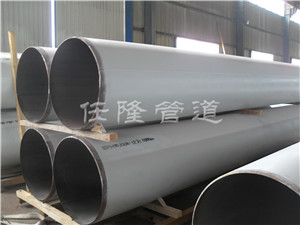
Longitudinal Welded Pipe
Longitudinal welded pipe refers to a steel pipe whose weld seam runs parallel to the longitudinal direction of the steel pipe. It is also commonly known as straight seam welded pipe or straight seam steel pipe. It is manufactured by rolling long steel strips of specified specifications through high-frequency welding units and performing straight seam welding. The specifications of longitudinal welded pipes are indicated by nominal bore diameters. In terms of wall thickness, they are divided into thin-walled longitudinal welded pipes and thick-walled longitudinal welded pipes. By shape, they can be classified into round, square and special-shaped pipes.
### Classification by Weld Seam Shape
They are categorized into straight seam welded pipes and spiral welded pipes.
1. Straight seam welded pipe: It features simple production processes, high production efficiency, low cost and rapid development.
2. Spiral welded pipe: It generally has higher strength than straight seam welded pipes. It can produce large-diameter welded pipes from narrow raw materials, and can also manufacture welded pipes of different diameters using raw materials with the same width. However, compared with straight seam welded pipes of the same length, its weld length increases by 30% to 100%, and the production speed is lower. Therefore, straight seam welding is mostly adopted for small-diameter welded pipes, while spiral welding is widely used for large-diameter welded pipes.
### Classification by Application
Welded pipes are classified by usage into general welded pipes, galvanized welded pipes, oxygen-blowing welded pipes, electric wire conduits, metric welded pipes, roller pipes, deep well pump pipes, automotive pipes, transformer pipes, electric welded thin-walled pipes, electric welded special-shaped pipes and spiral welded pipes.
General welded pipe: It is mainly used for conveying low-pressure fluids. It is made of Q195A, Q215A and Q235A steel, as well as other easily weldable mild steel. The steel pipes need to undergo hydraulic pressure, bending, flattening and other tests with specific surface quality requirements. The standard delivery length ranges from 4 to 10 meters, and fixed-length or multiple fixed-length delivery is usually required. The specifications of welded pipes are marked by nominal bore diameters (in millimeters or inches), which differ from the actual inner diameters. According to specified wall thicknesses, welded pipes are divided into standard steel pipes and thickened steel pipes. Based on pipe end forms, they are further classified into threaded and non-threaded types.