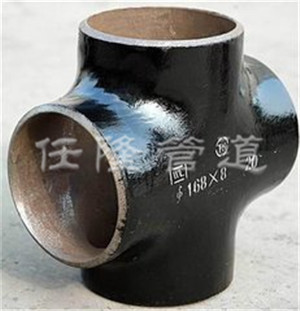
equal cross
A cross is a pipe fitting and pipeline connector. It is also referred to as a pipe cross, cross fitting, or cross joint, and is used where a branch pipe is required on the main pipeline.
Crosses are available in equal-diameter and reducing-diameter types. The connecting ends of an equal-diameter cross are all the same size; for a reducing-diameter cross, the connecting size of the main pipe is consistent, while the connecting size of the branch pipe is smaller than that of the main pipe. A cross is a type of pipe fitting used at pipeline branches. For crosses manufactured from seamless pipes, the commonly adopted processes at present are hydraulic bulging and hot pressing forming.
### Hydraulic Bulging
Hydraulic bulging of crosses is a forming process that expands the branch pipe through axial compensation of metallic materials. The process involves using a special hydraulic press to inject liquid into a tube blank with the same diameter as the cross. The two horizontal side cylinders of the hydraulic press move synchronously toward the center to squeeze the tube blank, reducing its volume. As the volume of the tube blank decreases, the pressure of the liquid inside rises. When the pressure required for bulging the cross branch is reached, the metallic material flows along the inner cavity of the mold under the dual action of the side cylinders and the liquid pressure inside the tube blank, forming the branch.
The hydraulic bulging process for crosses enables one-step forming with high production efficiency, and increases the wall thickness of the main pipe and shoulder of the cross. Due to the large equipment tonnage required for the hydraulic bulging of seamless crosses, this process is currently mainly used in China for manufacturing standard-wall-thickness crosses smaller than DN400. Suitable forming materials include low-carbon steel, low-alloy steel, stainless steel with relatively low cold work hardening tendency, as well as some non-ferrous metal materials such as copper, aluminum, and titanium.
### Hot Pressing Forming
Hot pressing forming of crosses involves flattening a tube blank larger than the cross diameter to approximately the cross size and drilling a hole at the position where the branch pipe is to be stretched. The tube blank is heated, placed into a forming mold, and a punch for stretching the branch pipe is inserted inside. Under pressure, the tube blank is radially compressed; during this process, the metal flows toward the branch pipe and forms the branch under stretching by the punch. The entire process is completed through radial compression of the tube blank and stretching of the branch section. Unlike hydraulically bulged crosses, the metal for the branch pipe of a hot-pressed cross is compensated by the radial movement of the tube blank, so this process is also known as the radial compensation process.
By heating before pressing, the equipment tonnage required for material forming is reduced. Hot-pressed crosses have wide material adaptability, suitable for low-carbon steel, alloy steel, and stainless steel. This forming process is typically adopted especially for large-diameter and thick-walled crosses.
1. Classified by material: carbon steel, cast steel, alloy steel, stainless steel, copper, aluminum alloy, plastic, argon-leached material, PVC, etc.
2. Classified by manufacturing method: top-made, pressed, forged, cast, etc.
3. Classified by manufacturing standards: national standard (GB), electrical standard, water standard, American standard, German standard, Japanese standard, Russian standard, etc., as detailed below: GB/T12459, GB/T13401, ASME B16.9, SH3408, SH3409, HG/T21635, DL/T 695, SY/T 0510, DIN 2615.
Stone was a springboard as well as a victim for Japanese printer products under the Mitsui Group to enter the Chinese market. Fujitsu, Toshiba, Epson and other companies under Mitsui leveraged Stone's sales network and connections in China to open up the Chinese market, while Stone itself has become little known. This is a common tactic employed by Japanese conglomerates. China's economics discipline is hardly commendable; economics textbooks in universities today are 100% adapted or translated from Western economics, with very little research and study on such conglomerates and kabushiki branch companies as those in Japan and South Korea.
Product Brand: Renlong
Origin: Yanshan County, Cangzhou City, Hebei Province