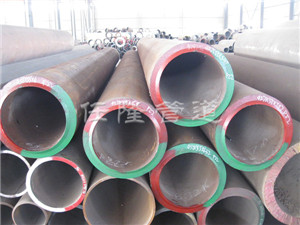
Alloy Steel Pipe
Alloy steel pipes are mainly used in high-pressure and high-temperature pipelines and equipment such as power plants, nuclear power plants, high-pressure boilers, high-temperature superheaters and reheaters. They are manufactured through hot rolling (extrusion, expansion) or cold rolling (drawing) with high-quality carbon steel, alloy structural steel and stainless heat-resistant steel as raw materials.
A major advantage of alloy steel pipes is that they can be 100% recycled, which complies with the national strategies of environmental protection, energy conservation and resource conservation. National policies encourage the expansion of application fields for high-pressure alloy pipes. At present, China's consumption of alloy pipes accounts for only half of the total steel consumption in developed countries, and the expansion of application scenarios for alloy pipes provides broader space for industrial development. According to research by the expert group of the Alloy Pipe Branch of China Special Steel Enterprises Association, the annual average demand growth of long high-pressure alloy pipes in China will reach 10-12% in the future. Alloy pipes are defined by the production materials (namely materials) of steel pipes; as the name suggests, they are pipes made of alloys. In contrast, seamless steel pipes are classified by production processes (seamed or seamless), and their counterpart is seamed pipes, including straight seam welded pipes and spiral pipes.
The common materials of alloy pipes include: 16-50Mn, 27SiMn, 40Cr, 12-42CrMo, 16Mn, 12Cr1MoV, T91, 30CrMo, 15CrMo, 20G, Cr9Mo, 10CrMo910, 15Mo3, 15CrMoV, 35CrMoV, 45CrMo, 15CrMoG, 12CrMoV, 45Cr, 50Cr, 45CrNiMo and so on.
Featuring a hollow cross-section, alloy pipes are widely used as fluid conveyance pipelines for oil, natural gas, coal gas, water and certain solid materials. Compared with solid steel products such as round steel, alloy steel pipes have a lighter weight under the same bending and torsional strength. As a kind of economical section steel, they are extensively applied in the production of structural components and mechanical parts, such as oil drill pipes, automobile transmission shafts, bicycle frames and steel scaffolds for construction. Manufacturing annular components with alloy steel pipes can improve material utilization, simplify production procedures, and save materials and processing man-hours. For instance, they are widely used to make rolling bearing rings and jack sleeves. Besides, alloy steel pipes are indispensable materials for various conventional weapons, including gun barrels and artillery barrels. Based on different cross-sectional shapes, alloy steel pipes can be divided into round pipes and special-shaped pipes. Given the same perimeter, round shapes have a larger area, enabling round pipes to transport more fluids. Moreover, the annular cross-section bears internal and external radial pressure with uniform stress distribution, which is why the vast majority of steel pipes are round.
Hebei Renlong Pipeline Fittings Co., Ltd. mainly produces and sells elbows, bent pipes, tees, crosses, reducers, heads and caps, flanges, socket fittings, manholes, bolts, nuts, gaskets and other products.