
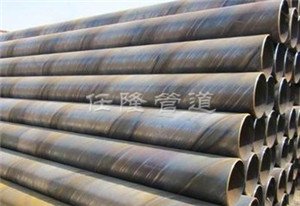
Description
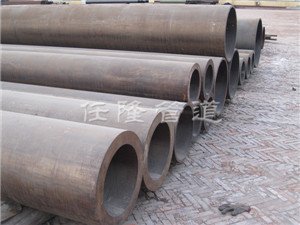
Spiral pipe, also known as spiral steel pipe or spiral welded pipe, is manufactured by rolling low-carbon structural steel or low-alloy structural steel strip into a tube blank at a certain spiral angle (forming angle), then welding the pipe seam. It enables the production of large-diameter steel pipes using relatively narrow steel strips.
# Production Process
(1) Raw materials include steel strip coils, welding wires and welding fluxes, all of which must undergo strict physical and chemical inspection before being put into production.
(2) The head and tail of steel strips are butt-welded by single-wire or double-wire submerged arc welding, and automatic submerged arc welding is adopted for repair welding after the strips are rolled into steel pipes.
(3) Before forming, the steel strip is processed through flattening, edge shearing, edge planing, surface cleaning, conveying and pre-bending.
(4) Electric contact pressure gauges are used to control the pressure of the pressing hydraulic cylinders on both sides of the conveyor to ensure the stable conveying of the steel strip.
(5) External control or internal control roll forming is adopted.
(6) A weld gap control device is applied to ensure the weld gap meets welding requirements, with strict control over pipe diameter, edge misalignment and weld gap.
(7) Both internal and external welding adopt Lincoln electric welding machines from the United States for single-wire or double-wire submerged arc welding to achieve stable welding parameters.
(8) All welded seams are inspected by an on-line continuous automatic ultrasonic flaw detector, achieving 100% non-destructive testing coverage of spiral welds. If defects are detected, the device will automatically alarm and spray marks. Production workers adjust process parameters timely accordingly to eliminate defects immediately.
(9) Steel pipes are cut into single lengths by an air plasma cutting machine.
(10) After being cut into single pipes, each batch of steel pipes shall undergo strict initial inspection, covering mechanical properties of welds, chemical composition, fusion condition, surface quality of steel pipes and non-destructive flaw detection. Only after confirming the pipe making process is qualified can the pipes be officially put into delivery.
(11) Parts with continuous acoustic flaw detection marks on welds shall be rechecked by manual ultrasonic testing and X-ray inspection. If defects are confirmed, they shall be repaired and then subjected to non-destructive testing again until the defects are completely eliminated.
(12) All pipes with butt welds of steel strips and T-joints intersecting with spiral welds shall be inspected by X-ray television or radiographic filming.
(13) Each steel pipe undergoes a hydrostatic test with radial sealing for pressure application. The test pressure and holding time are strictly controlled by a microcomputer water pressure detection device for steel pipes, and test parameters are automatically printed and recorded.
(14) Mechanical processing is performed on pipe ends to precisely control the end face perpendicularity, bevel angle and root face.
Reviews
There are no reviews yet.